Episode 39
Episode 39 show notes
To view or buy the books featured in this episode, please see the links below.
- Recommended children’s and YA books released in March 2026 – buy from UK Bookshop Org.
- February 2026 school book club recommendations.
Affiliate Statement
As an Amazon Associate, the School Reading List earns from qualifying purchases. Disclosure: If you buy books linked to our site, we may earn a commission from uk.bookshop.org.
This podcast is supported by its listeners. If you choose to purchase something using links on our website or podcast notes, we may earn a commission. No books were warped, dog-eared, underlined with purple pen, eaten, cursed, cancelled, burned, or otherwise harmed in the making of this podcast.
Listen and subscribe
To listen to all the episodes in this podcast and to subscribe, see the School Reading List podcast page.
Episode 39 transcript
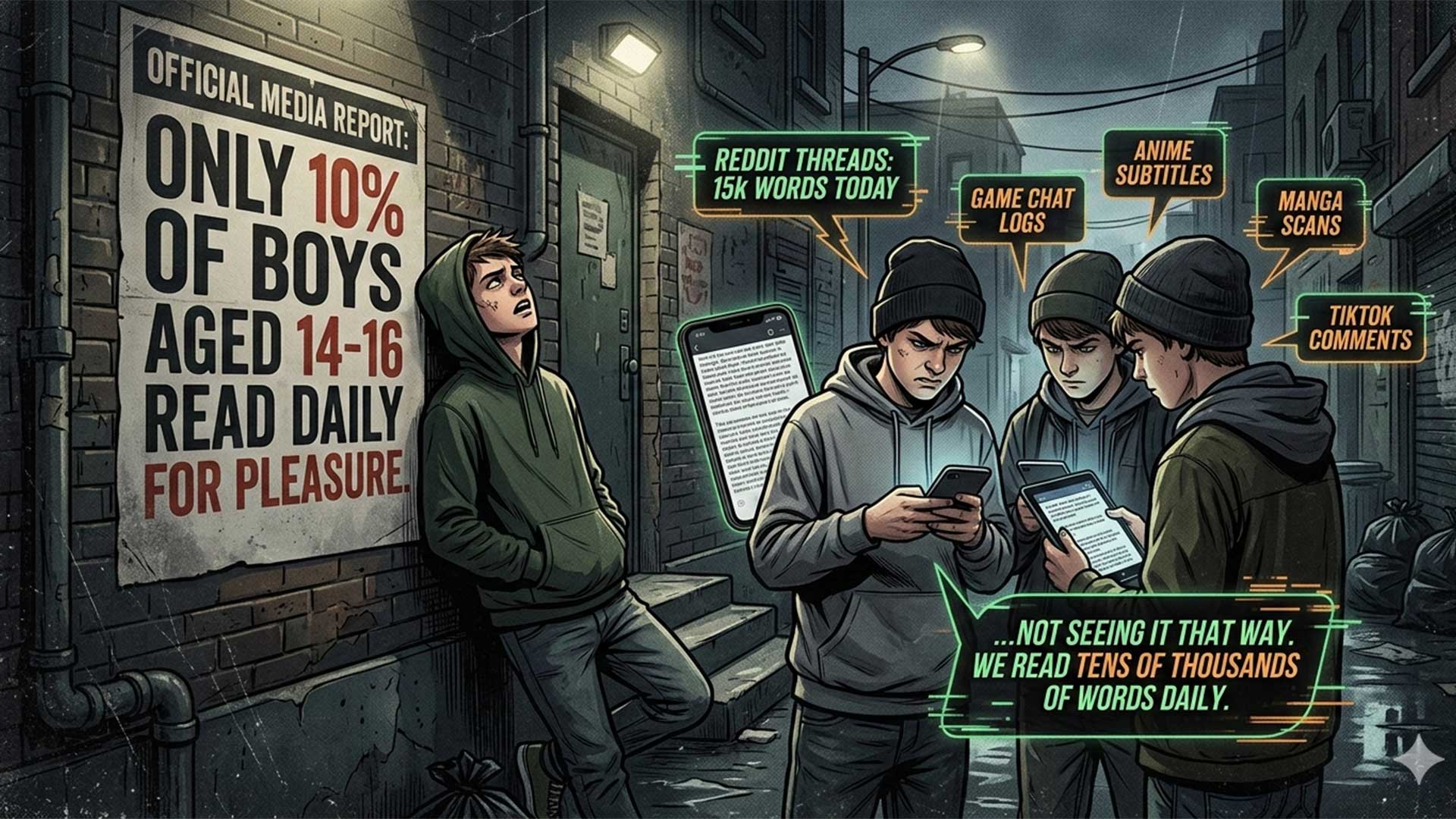
“Only 10% of boys aged 14-16 read daily for pleasure”
According to a recent report by the National Literacy Trust, “Only 10% of boys aged 14-16 read daily for pleasure”.
Is this true, and if so, what can we as teachers, do about it? How much do boys aged 14-16 actually read, why is this the case, and how can schools improve this situation?
If you ask a room of Year 10 boys whether they “read”, you will often get a quick answer. And it might not involve many book titles.
But if you ask what they read in a normal week, you get a longer, more useful story: group texts, gaming chat, Wikipedia rabbit holes, subtitles, lyrics, match reports, messages, short articles, sometimes comics, sometimes a novel that takes off and is finished in days.
The gap between those two answers sits at the heart of the problem schools are trying to solve.
The cleanest UK-wide snapshot we have right now comes from the National Literacy Trust’s large annual survey work. In 2025, only 9.8% of boys aged 14-16 said they read daily in their free time, and 18.8% said they enjoyed reading in their free time. Girls of the same age were higher on both measures, with 17.6% reading daily and 37.7% enjoying reading. Page four of the report puts it plainly: “Daily reading becomes uncommon by mid-adolescence”.
Those figures matter because they describe habit, not capability. “Daily in free time” is a simple threshold: does reading show up as a normal part of life, or as something occasional? By mid-adolescence, the Trust’s data suggests it is unusual for boys. That pattern has been visible for years in international assessments too. PISA repeatedly finds large gender gaps in reading, and in 2018 most 15-year-old boys across OECD countries reported either no reading for enjoyment or less than half an hour a day.
It is also worth being honest about what these measures sometimes miss. Surveys usually treat “reading” as a choice activity and often prompt with questions about books. Teenagers, especially boys, often describe examples of reading that are folded into other things: online forums, fan fiction, streaming media subtitles, walkthroughs, sports news, life tips, fitness and diet guides, fantasy football discussions and so on.
The National Literacy Trust report leans into this and notes that young people now engage with text in many formats, and that we need to look beyond narrow measures: “Young people encounter and engage with text across a wide range of formats”. Later, it flags the same issue in teenagers’ own words, observing that some boys read through games and subtitles even when they do not identify as book readers: “Reading takes different forms” including “games, subtitles or online content”.
One example from our research: each Star Trek Starfleet Academy episode, when watched with subtitles – and today’s teens love subtitles – contains 8000 – 10000 words. It’s reading, Jim, but not as we know it.
So why does reading allegedly drop so sharply at 14-16? Start with time and energy. GCSE courses intensify, homework expands, and evenings fill up with sport, jobs, caring responsibilities, commuting, screens and social life. Teenagers describe time pressure and tiredness as major reasons reading is harder to fit in.
Then look at how reading is positioned in school. Many teenagers say they like reading when they control it, and disengage when it feels imposed, monitored, or tied to written accountability that kills momentum. One boy’s comment in the report captures the resentment clearly: “I actively despise how schools force you to write a summary of your reading”.
Relevance is the other big lever. In the Trust survey, the most common things teenagers say would encourage them to read more are straightforward: books that match their interests, freedom to choose, and links to familiar media such as a film or TV series. For boys aged 11-16, the report quantifies this: 40.5% selected “finding books that match my interests/hobbies”, 36.8% selected reading a book linked to film/TV, and 30.7% selected being free to choose what they read.
There is also a skills and access layer that schools sometimes underestimate. Some 14-16 boys avoid reading because it is slower, effortful, or frustrating. Dyslexia and attention difficulties come up directly in teenagers’ comments, alongside descriptions of tracking text and sustaining concentration.
All of this sits inside a bigger cultural story. According to research, many boys still pick up the message that reading, especially fiction, is not a “normal” masculine leisure choice. OECD analysis of PISA data notes that boys are more likely to frame reading as information-gathering, and researchers link some of this to identity and peer status, with reading sometimes coded as feminine in adolescent culture.
None of this means reading is optional. Longitudinal work in the UK has found that teenagers who read regularly through adolescence show stronger cognitive outcomes, including vocabulary, by age 16.
The National Literacy Trust also states the education case plainly and cites wider evidence that regular reading during 10-16 is linked with cognitive progress, referencing Sullivan and Brown (2014).
So what can schools do that actually fits the lived reality of 14-16 boys?
First, protect time in the timetable and make it easy to start. If reading only relies on “free time”, it loses to everything else. The most practical school move is still carving out a short, consistent reading slot where pupils can read something of their choosing with no immediate written task attached. This connects with what boys say about routine. The report notes that boys’ reading is often sustained by “habit, routine or perceived usefulness” and becomes easier to displace as routines weaken.
Second, treat choice as the main strategy, not a reward. Boys in the Trust data repeatedly say they read more when the material matches their interests and when they are not forced through a narrow diet of “approved” texts. That does not mean abandoning quality. It means building ladders: short books, series starters, non-fiction that is genuinely expert and current, sports writing, graphic novels, narrative non-fiction, humour, horror, myth retellings, and books linked to games or films. It also means teaching pupils how to browse and abandon without shame. If every abandoned book is treated as failure, boys stop sampling and stop finding the book that clicks. One line in the report captures the “click” effect: “When I find a book I love I demolish it within days”.
Third, widen what counts as reading, then use that as a bridge to longer texts. Many boys already read a lot of text while claiming they do not read. Schools can work with that, not against it: articles, manuals, match analysis, long-form journalism, website explainers, scripts, subtitles, and game narratives can all build stamina if teachers name them as reading and help pupils move from short bursts to longer arcs. The Trust report explicitly lists these examples: boys describe reading digitally “through games, subtitles or online content”, and boys also say directly: “I enjoy reading subtitles and text messages and comment sections.”
Fourth, stop accidental sabotage. Some well-meant systems reduce reading: heavy reading logs, compulsory written reviews, public point-scoring that embarrasses reluctant readers, or over-testing that turns reading into yet another performance. The report includes teenagers who say forced summaries and journals put them off.
Schools do need accountability, but it can be lighter touch: quick book-talk, informal recommendations, teacher conversations, or opt-in sharing rather than compulsory output every time.
Fifth, invest in the library as a social space, not a museum. Many boys describe reading as solitary and say they prefer social time with friends instead. Libraries that feel like places to be, not places to be judged, are more likely to hold older teens. This is also where formats matter: manga, graphic novels, magazines, sports writing, short story collections and accessible non-fiction can make the room feel relevant.
Sixth, make reading everybody’s job in a practical way. The most credible route is disciplinary literacy: every subject teaching the reading it genuinely requires, with explicit support for vocabulary, complex sentences, and subject-specific text types. That aligns with EEF guidance on secondary literacy. It also fits what boys say about usefulness, since the report highlights that boys’ motivations often centre on learning new things and new words.
School Reading List’s annual reading-for-pleasure survey work points to a clear pattern: boys are often keen on books when reading gives them a quick entry access and a strong payoff. Imagination-led stories land well, as do formats that feel immediate, especially graphic novels and manga. Longer novels are not automatically rejected, but books with lots of shorter chapters tend to get finished more often, partly because they fit into small gaps in the day.
Another recurring preference is structure. Many respondents gravitate towards books with a defined, familiar “engine” and a satisfying plot shape, including contemporary stories that borrow the steady momentum of procedural fiction. Standalone reads also come up repeatedly, suggesting a “dip in and dip out” habit that mirrors how many teens consume streaming drama. The themes boys mention most are forward-looking and positive rather than bleak: escapism, survival, second chances, redemption, social recovery after a public mistake, and going from being overlooked to being respected and seen. In School Reading List’s tracking, the authors boys aged 14-16 are returning to include Malcolm Duffy (look at Dead Straight Line), Tia Fisher, Joseph Coelho, Nathanael Lessore, Luke Palmer, Phil Stamper, Brian Conaghan, James Goodhand, David Arnold, Ben Oliver and Alex Wheatle.
Generational assumptions can also scramble the conversation, because “read daily for pleasure” means different things depending on who you ask. Many teachers hear “reading” and picture a suitable book. Librarians often include fiction, non-fiction, poetry, graphic novels, newspapers and magazines. Some parents default to anything printed. Policymakers want a clean metric for programmes like the National Year of Reading. But teenagers live in a wider text environment: messages, webpages, social posts, game text, comment threads and subtitles, plus the caption-heavy culture of short-form video.
That is where the false comparisons creep in. Adults may see “screens” as the opposite of reading, while teens can genuinely be processing huge volumes of words every day, just not in a hardback. There is a historical echo here too. In the 1980s and 1990s, text-heavy adventure games and magazines were dismissed as low value, yet many required sustained reading of 10,000+ words to play or follow. Today’s version is subtitles. UK surveys commissioned by Stagetext and reported alongside a YouGov poll found very high subtitle use among 18 to 24 year olds, including 61% saying they generally have subtitles on. That does not prove teenagers are building deep reading stamina, but it does show that a lot of young people now choose to read while they watch, often for convenience and focus rather than disability access. If schools only recognise book-shaped reading, they risk missing what teenagers already do well, and they risk signalling that their real reading lives do not count.
So, a more honest headline might be this: by 14-16, daily voluntary reading is rare for boys in the UK, according to current survey measures.
The more hopeful point is that many boys still describe reading as enjoyable, calming, and useful, and they do read plenty of text in other formats. Schools get traction when they stop arguing with teenage life and start designing reading that survives it: protected time, real choice, formats that feel relevant, fewer punitive add-ons like questionnaires, quizzes and reviews, and a library culture that looks like Year 10 belongs there.
But, too often, much of reading in the world of teen boys is clouded by older generations’ perceptions. Ask yourself this, which of the following is more likely? You as an adult teacher managing 10,000 steps per day? Or your Year 10 student reading (in any format) 10,000 words per day? You might be surprised!
Further reading and resources:
- National Literacy Trust landing page for the February 2026 report Teenage reading: (Re)framing the challenge.
- OECD PISA 2018 Results (Volume II) section on students’ reading engagement, including time spent reading for enjoyment and gender patterns.
- Evidence that subtitle use is highest among 18 to 24 year olds in the UK, including the YouGov finding that 61% generally keep subtitles on.
- Reporting based on an AP NORC poll explaining why younger adults increasingly use subtitles, including multitasking and unclear dialogue.
- Ofcom data cited in reporting showing that young people spend far more time on streaming and video-sharing platforms than live TV, which helps explain where captioned viewing happens.
- UCL Centre for Longitudinal Studies summary of research linking reading for pleasure with later educational outcomes.
- School Library Association page reporting on UK reading engagement research and school reading context.
- Ofcom document on accessibility best practice for TV and on-demand services, relevant to subtitle and caption use.
- University of Nottingham news summary of research on subtitles and early reading skills, useful for caution about claims on subtitles improving reading.
- National Literacy Trust report on school libraries, covering usage patterns and links with literacy engagement and wellbeing.
- School Library Association page on social reading spaces as a school-based approach to supporting adolescent reading.
- Education Endowment Foundation’s Improving Literacy in Secondary Schools guidance report, hosted via the Chartered College portal.
Episode 39 chapter markers
Part 1
Part 2
Part 3
Episode 39 credits
To see full details of licensing information, Creative Commons, GNU license credits and other attributions that apply to every episode of this podcast, see our School Reading List podcast credits information page.
Credits specific to this episode
- Kevin MacLeod – Bummin on Tremelo – (purchased lifetime extended license registered to Tom Tolkien license ID FML-170359-11969).
- Listener submitted monologues from debut and self-published authors. For more details, see the podcast episode’s details page.
Ask us a question | Leave us a voicemail shout-out
Click the button below to leave us a voicemail via SpeakPipe, if you would like to ask a question for one of our listeners’ message slots, leave a shout-out or be featured in a future episode.
Buy me a coffee
If you found this free podcast useful and you would like to help, please consider a donation through the ‘Buy Me a Coffee’ service. Thanks.