The Bluest Sky – at a glance
The School Reading Lists’ five word review: Family, choice, secrecy, risk, migration.
Children’s book title: The Bluest Sky.
Children’s author: Christina Diaz Gonzalez.
Genre: Children’s fiction, historical, middle grade novel.
Published by: Knopf Books for Young Readers.
ISBN: 9780593372791.
Recommended for children aged: 10+.
First published: Hardback September 2022.
This children’s book is ideal for: : Children interested in migration, how the state controls its citizens, family separation, and Cold War contexts in upper KS2 and lower KS3.
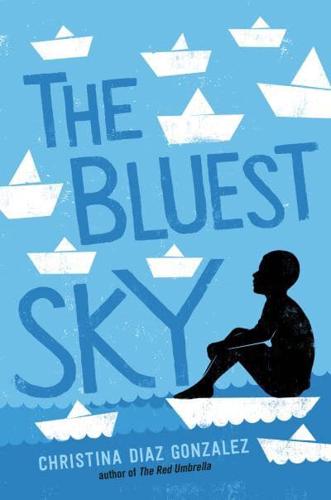
To see the latest price or order, click on the book cover image. As an Amazon Associate, schoolreadinglist.co.uk earns from qualifying purchases.
Our review:
Set in Cuba in 1980, The Bluest Sky follows Héctor as he tries to keep his public face in step with his private beliefs. His father has been jailed and then sent to the United States. His mother is deciding whether to leave. His grandmother sits in the National Assembly, which means people pay attention to what the family says and does. Neighbours watch. Officials notice. When the Mariel boatlift opens a narrow window, the family has to choose between staying and starting over elsewhere. That decision strains friendships and unsettles their standing in the community, and the acts of repudiation at their door turn a difficult conversation into a plan that cannot be ignored.
Héctor ends up living in two versions of himself. In school and on the street, he performs loyalty because that is what is expected. At home, he speaks more freely. The split makes life hard with friends and even complicates his maths ambitions. He wants to represent Cuba, but the mix of surveillance, denunciation, and small favours is always there. Food arrives through a connection. Phone calls are cautious. Any conversation might carry further than intended.
The plot moves through vivid scenes from the Mariel period. A crowd gathers for an act of repudiation. Threats come close to the family’s front step. A death shifts the path out of the country. The family files requests and waits, and the queues and forms decide who moves and who does not. Boat places are limited. Families split. Routes twist. Street language marks insiders and those dismissed as “gusanos,” which grounds the setting for readers new to twentieth-century Cuba.
The subject matter is well-suited for classroom work in UKS2 and KS3. Identity and performance, family and allegiance, and friendship and secrecy are all key themes. The book shows how a child measures risk and decides whom to trust, and how a policy written far away can land on one doorstep on one day. The final chapters follow decision, preparation, departure, and reception, which makes the journey easy to map in lessons. The novel also sits well alongside other stories about migration and refugees.
Our verdict:
This is a strong class text for units on migration and state power because pupils can build arguments from the page without needing much prior context. Scenes grow out of daily choices and family conversations, so it is straightforward to quote for character goals, pressures, and turning points. The 1980 timeline and the Mariel boatlift give a clear spine for retrieval tasks. It also fits book clubs that compare historical settings across middle-grade titles.
For KS2 and KS3, the links to history and PSHE are obvious. In history, it supports work on the Cold War, state control, propaganda, reasons for migration, and reception in host countries. In PSHE, it prompts discussion about belonging, peer influence, safe and unsafe choices, how groups enforce rules, and what support can look like. In English, it lends itself to lessons on viewpoint, reliable and unreliable narration, and how a first-person voice can reveal or withhold key facts. The structure is workable across six to eight weeks, with space for context lessons and follow-up writing.
Teaching points and book club discussion ideas:
- Build a dual-identity chart. List what Héctor says and does in public and in private. Add evidence and page references.
- Compare labels. “Citizen,” “enemy,” “gusano,” “friend,” “family.” Record who uses each term and with what effect on behaviour.
- Write a one-page brief from Héctor to his future self. Include three risks, three hopes, and three unknowns before departure.
- Chart the decision pathway. Mother’s plan, grandmother’s influence, brother’s role, father’s distance. Assign a symbol or colour to each actor and track over chapters.
- Migration case study. Compare this narrative with another country’s exit routes. Identify similarities and differences in policy, risk, and reception.
- Teacher resources: Penguin Random House educator guide with discussion questions, themes, and cross-curricular tasks.
Many thanks to Knopf Books for the review copy.
To order a class set of this book, please click below to order via uk.bookshop.org, an organisation that supports local bookshops, or Amazon.co.uk.
Buy from UK.Bookshop.Org Buy from Amazon.co.uk
Disclosure: If you buy books using the buttons above, we may earn a commission from Bookshop.org, whose fees support independent bookshops; as an Amazon Associate, schoolreadinglist.co.uk earns from qualifying purchases.
Browse our Year 7 reading list.

