Dead Straight Line – at a glance
School Reading Lists’ five word review: risky teen game serious consequences.
YA book title: Dead Straight Line.
YA author: Malcolm Duffy.
Genre: Contemporary YA novel.
Published by: Zephyr.
ISBN: 9781035919277.
Recommended for children aged: 12+.
First published: April 2026.
This YA book is ideal for: readers who want a fast novel about teen risk-taking, blame culture, and responsibility.
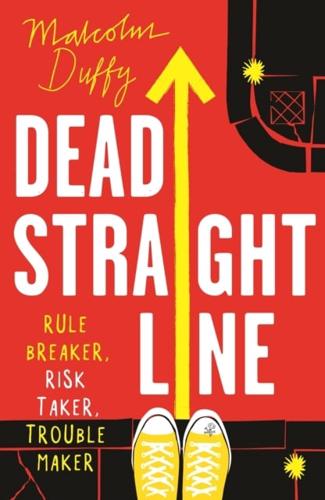
To see the latest price or order, click on the book cover image. As an Amazon Associate, schoolreadinglist.co.uk earns from qualifying purchases.
Our review:
It’s simple. Wherever you are, you have to get home in a dead straight line. Never mind what’s in the way, or which rules you have to break. The game 16-year-old Rory concocts is as enticing in the story as it is thought-provoking in real life. But what Rory cannot foresee is how it will change his world and wreck his friend Elliot’s life.
After the accident, consequences hit hard at home and at school, and an angry Rory is sent to volunteer in a care home. There, he meets Tanker, an outspoken disabled war veteran who provides hope, slowly reshaping how Rory sees himself and his actions. Inspired by the author’s own experience and his interest in the risks that teenagers take, Dead Straight Line looks at what happens when things go horribly wrong.
Initially, when Rory is held responsible, Rory just doesn’t get it, and a lot of teens will see life through Rory’s lens. What is consent, what is coercion, what is peer pressure, and what is common sense? How have these concepts changed over time? Not long ago, people would have scolded the victim and asked him if he’d jump off a cliff if someone asked him to. Now someone has to be held to account, and social media commentary, snap opinions and an indefinable general feeling all snowball into an uncompromising, unstoppable truth. This is public cancellation at a local, familial and personal level, and there is seemingly no recourse.
The concept is darkly tempting. To teens, the title of the book is like a hashtag to throw into conversation. Most will swear they’d never take such risks, but privately many will empathise with Rory’s actions. Schools, librarians and bookshops will have no problem persuading KS3 and KS4 students to read it. Yet I suspect this novel’s popularity will spread through viral word of mouth from readers, and not traditional publicity.
Dead Straight Line explores teen logic in clinical detail, and how it rubs like sandpaper against the unforgiving, professional adult world of blame culture, acceptable behaviour and expectations of maturity. Characters are revealed in short blasts of relatable dialogue. The events are pieced together through emotive memory fragments, argumentative replies and a deepening sense of unfairness and disillusionment.
The second half of the book offers refreshing hope and inspiration through Rory’s burgeoning relationship with Tanker and gradual acceptance of his situation. It’s Tanker, and not figures of authority or the community, who shows Rory how to weigh up the pros and cons of decisions, consider consequences and think before he acts. That, especially, will resonate with teen readers.
Dead Straight Line poses crucial questions. When does an accident become an accident waiting to happen, and when does a stupid decision deserve lifelong shame? How much does teenage life rely on friendship and trust, and how easy is it to lose everything through one mistake? And most importantly of all, how can Rory, his community and society in general put things right?
Our verdict:
It is rare to read a book that will touch such a disparate bundle of nerves, depending on who reads it.
The premise is powerful, and every 13-year-old will be able to elevator pitch this novel. KS3 and KS4 will want to read this book before they have physically picked it up, and that’s rare in 2026.
The chapters are punchy, the pace is fast, and the prose is highly accessible. Many children will read it in one sitting, and many will also keep returning to it to pick over the nuances and think about their own lives. It’s perfect for English lessons in Years 8, 9 and 10, and it will provoke a lot of discussion.
Adults who read this novel may well feel unsettled by the plausible, inevitable plot as it develops, event by event, within the realms of contemporary life, online reaction and stifling community stigma.
Dead Straight Line meets readers, teachers and schools in a perfect storm of teen alienation, toxic masculinity, lack of opportunities for youth, crushing societal expectations, punitive school sanctions systems and a disturbing vacuum of male role models. The disconnect between the boy’s view of the world, his value system, and public opinion, is spot on.
Perfectly pitched and unerringly relevant, this is an outstanding story for 12+ year olds that explores trust and responsibility. Every Year 8 and Year 9 student should read it, and it will grip early teens in the same way Kes by Barry Hines did a couple of generations ago.
Dead Straight Line is the best YA novel I have read in the past 10 years.
Many thanks to Zephyr for the review copy.
To order a class set of this book, please click below to order via uk.bookshop.org, an organisation that supports local bookshops, or Amazon.co.uk.
Buy from UK.Bookshop.Org Buy from Amazon.co.uk
Disclosure: If you buy books using the buttons above, we may earn a commission from Bookshop.org, whose fees support independent bookshops; as an Amazon Associate, schoolreadinglist.co.uk earns from qualifying purchases.
Browse our Year 8 reading list.

