Episode 46
Episode 46 show notes
To view or buy the books featured in this episode, please see the links below.
- Recommended children’s and YA books released in November 2026 – buy from UK Bookshop Org.
- October 2026 school book club recommendations.
- Alastair Humphreys talks about adventure reading, young explorers and his latest book, Canoe Challenge.
Affiliate Statement
As an Amazon Associate, the School Reading List earns from qualifying purchases. Disclosure: If you buy books linked to our site, we may earn a commission from uk.bookshop.org.
This podcast is supported by its listeners. If you choose to purchase something using links on our website or podcast notes, we may earn a commission. No books were warped, dog-eared, underlined with purple pen, eaten, cursed, cancelled, burned, or otherwise harmed in the making of this podcast.
Listen and subscribe
To listen to all the episodes in this podcast and to subscribe, see the School Reading List podcast page.
Episode 46 transcript
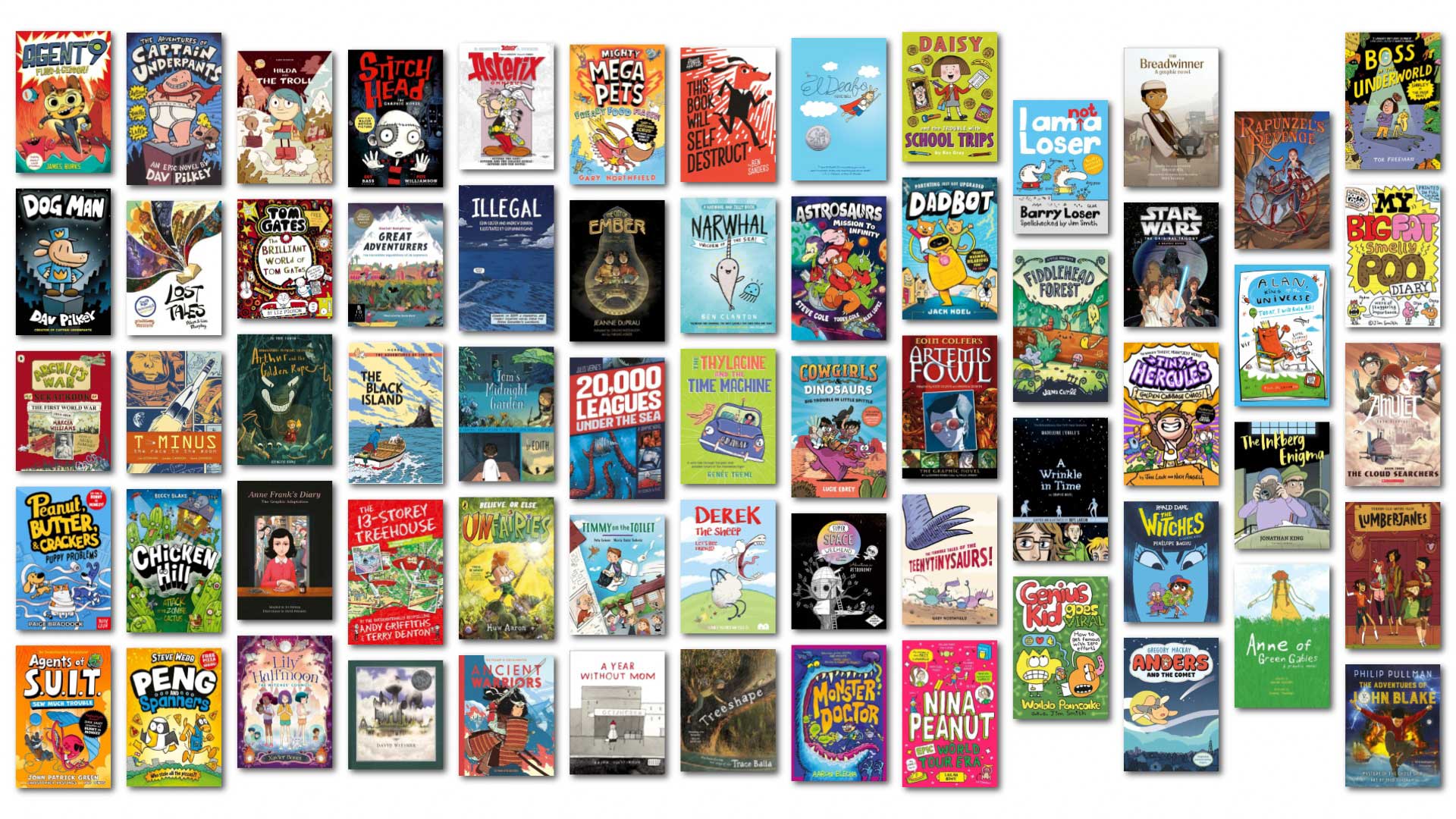
Bigger ideas, smaller books: why upper KS2 and KS3 need more ambitious and affordable graphic novels
Perhaps the next big opportunity in children’s publishing isn’t simply to produce more graphic novels. It’s to make them more challenging, more varied and more affordable. Particularly for children in Years 5 to 9, who may be ready for increasingly sophisticated stories without necessarily wanting hundreds of pages of conventional prose.
For years, schools have debated whether comics count as proper reading. That argument increasingly feels outdated. The more interesting question is whether publishers are making enough of what visual storytelling can offer. Why should children have to leave pictures behind as their reading becomes more sophisticated?
This isn’t about replacing novels or suggesting popular comics are inadequate. It’s about offering more demanding stories through formats young readers already enjoy.
Children are reading comics. The evidence is increasingly clear.
The National Literacy Trust’s October 2026 report, Children and young people’s engagement with comics, found that 45.7% of children and young people surveyed read comics or graphic novels in their free time at least once a month. That’s an increase of 7.5 percentage points since 2025 and the highest level recorded since 2017.
The figures are especially striking among younger readers. Some 60% of 8 to 11-year-olds reported reading comics, compared with 33.5% of 16 to 18-year-olds. Among comic readers, 59.8% read them in print, 24.6% digitally and 15.6% in both formats.
More than 700 pupil comments highlighted immersion, visual storytelling, accessibility and relaxation. Children valued more than a reduced word count.
Meanwhile, the Trust’s wider 2026 research found that 36.1% of 8 to 18-year-olds enjoyed reading in their free time, a modest improvement on 2025. Only 20.3% reported reading daily. These findings don’t prove that graphic novels improve attainment, but they suggest visual narratives deserve serious consideration when schools think about sustaining reading enjoyment.
Accessible doesn’t have to mean easy
Accessibility doesn’t necessarily mean simplicity.
A book might contain relatively little text while asking its reader to perform considerable intellectual work. Graphic narratives can require readers to interpret facial expressions, connect events across panels, recognise symbolism and notice contradictions between what characters say and what the artwork reveals.
Sometimes the most important event happens in the space between two pictures. The reader must work out what occurred without being told. These are valuable interpretative skills, particularly when discussing inference, narrative perspective and unreliable narrators in English lessons.
Not every comic demands equal interpretation. Complexity isn’t determined by word count or the number of pictures.
Four books that show what’s possible
Àlàbá Ònájìn’s Korobá: The Case of the Missing Kolo, published by Scallywag Press in May 2026, is an encouraging example. Set in Makoko, Nigeria, the full-colour graphic mystery follows ten-year-old Korobá as she investigates the disappearance of her friend Saidat’s savings box.
The visual clues invite observation and deduction. At 144 pages and a published price of £8.99, it also demonstrates that original, full-colour graphic fiction needn’t always arrive as an expensive hardback.
For more demanding subject matter, there’s War by Eoin Colfer and Andrew Donkin, illustrated by Giovanni Rigano. Published in August 2026, it follows fourteen-year-old Kat as her home city is invaded, alongside Adam, a young conscript in the invading army.
The graphic novel examines displacement, divided loyalties and difficult moral choices. Illustrated interviews with refugees provide additional context. Its subject matter calls for individual judgement about emotional suitability, but it demonstrates how serious contemporary questions can be explored visually.
There’s a financial difference, however. War was published as a £16.99 hardback. One copy may be an excellent library purchase, but buying several for a school book club is a greater commitment.
Lize Meddings’ The Sad Ghost Club offers another kind of complexity. The graphic novel series, completed with its fifth volume in August 2026, explores anxiety, loneliness, friendship and belonging through understated dialogue and expressive artwork. Its emotional significance often emerges from what characters struggle to articulate.
Then there’s When the Birds Wake Up by Jessica Mary Ellis, illustrated by Sophie Burrows. Published by David Fickling Books in September 2026, it follows ten-year-old Pear as she encounters bullying, a new school and her grandmother’s Alzheimer’s disease.
This isn’t a graphic novel. It’s an illustrated verse novel, using poetry, other forms of writing and visual presentation to tell an emotionally demanding story. Its published £7.99 paperback price shows another way of combining literary ambition with affordability.
Together, these books suggest that sophisticated reading needn’t always mean increasingly dense prose, and visual storytelling doesn’t have to follow one publishing model.
What could publishers do differently?
Excellent graphic novels already exist for older children, including historical adaptations, manga, contemporary fiction and challenging non-fiction. The question is whether there is sufficient breadth, discoverability and affordable choice for readers moving through upper KS2 and KS3.
Imagine more original historical mysteries built around visual evidence, science-fiction stories about technological responsibility, or narratives exploring misinformation and conflicting accounts. Short, self-contained graphic novels might offer sophisticated plots in manageable reading sessions. Interactive stories could incorporate maps, diagrams and documents that readers genuinely need to investigate.
Publishers could experiment with black-and-white interiors, limited colour, compact paperback editions and serialised stories. Japanese manga provides an established example of predominantly monochrome storytelling in collectable paperbacks, though its commercial success cannot simply be reproduced by copying its physical design.
None of this guarantees lower costs. Illustration, lettering, editing and production involve specialist work, and colour can carry vital narrative meaning. Removing it from existing artwork may weaken the story. Creators also need to be paid properly.
Even so, it’s worth asking whether shorter, intellectually ambitious graphic novels could sit alongside conventional children’s paperbacks at similarly accessible prices.
The price problem for school libraries
Affordability matters because school book purchasing is rarely straightforward. In parliamentary evidence published in 2026, the School Library Association estimated that establishing libraries in approximately 484 secondary schools without provision could require up to £15 million in capital funding.
Its illustrative budget for a secondary school of 1,500 pupils allowed £21,000 for 3,000 books, assuming an average discounted cost of £7 per title. That puts a £16.99 illustrated hardback into perspective. Paperback editions, institutional discounts and multiple-copy sets could make a real difference.
Price alone isn’t everything. A durable £12.99 graphic novel borrowed repeatedly might represent better value than a cheaper book which nobody chooses. Schools need to consider circulation, longevity and how many readers each purchase serves.
NielsenIQ’s analysis of 2025 sales identified continued growth in children’s comic-strip fiction and graphic novels in the UK and Ireland. Its 2026 international analysis also identified substantial graphic-novel growth in several markets. These are encouraging signals, but retail sales don’t establish what individual school libraries need.
What schools can do now
Librarians could begin by auditing their collections for readers aged roughly 10 to 14. Are there enough challenging graphic novels alongside popular comic series? Do confident readers know where to find them? Are illustrated verse novels included in recommendations? Are some books routinely offered only to less confident readers?
A simple experiment would be to invite pupils to explore four contrasting books over a fortnight: a popular comic, a demanding graphic novel, an illustrated verse novel and a conventional prose novel. Ask which required the most concentration, which offered the richest ideas and which they would recommend. Compare their responses with acquisition costs and subsequent borrowing.
For some pupils with additional needs, illustrations and shorter passages may make reading more manageable. Others may find complicated panel arrangements, small lettering or busy pages difficult. Accessibility needs to be considered individually.
The Go All In National Year of Reading 2026 campaign encourages schools to connect reading with children’s existing interests and recognises different forms of reading. The House of Commons Education Committee’s July 2026 report also called for stronger school-library provision and greater attention to reading enjoyment, although its recommendations are not enacted policy.
More choice, not more homework
More ambitious graphic novels shouldn’t turn every comic into a lesson. Children still deserve humour, escapism and books they read simply because they’re fun.
Nor should comics be treated merely as stepping stones towards supposedly superior prose fiction. Visual storytelling is a literary form in its own right.
The opportunity is to make that choice richer. More original stories, more varied artistic approaches, more demanding ideas and more affordable editions could help pupils develop as readers without abandoning the formats they love.
Perhaps the question shouldn’t be when children are ready to move beyond books with pictures. It should be what more those pictures could help them read, question and understand.
Further reading and useful sources
- National Literacy Trust: Children and young people’s engagement with comics (2026) – Research into comic-reading habits, print preferences and visual storytelling.
- National Literacy Trust: Children and young people’s reading in 2026 – Survey findings on reading enjoyment, frequency and inequality.
- National Literacy Trust: Unlocking the power of comics – Explores the educational value of visual narratives.
- NielsenIQ: Bestsellers and trends in the UK and Ireland in 2025 – Sales trends for children’s graphic fiction.
- School Library Association: Supplementary evidence to the Reading for Pleasure inquiry – Illustrative school-library stock budgets and investment estimates.
- House of Commons Education Committee: A library in every school – Recommendations on school libraries and reading for pleasure.
- National Year of Reading 2026: Go All In schools programme – Resources connecting reading with pupils’ interests.
- Scallywag Press: Korobá: The Case of the Missing Kolo – Publisher details of the graphic mystery and its edition.
- Hachette: War by Eoin Colfer, Andrew Donkin and Giovanni Rigano – Publisher details for the graphic novel on conflict and displacement.
- Hachette Schools: The Sad Ghost Club Volume 1 – Publisher information on the series exploring friendship and anxiety.
- David Fickling Books: When the Birds Wake Up – Publisher introduction to the illustrated verse novel.
- School Reading List: Graphic novels for KS2 children – Recommendations for primary readers.
- School Reading List: Graphic novels for KS3 and KS4 – Recommended visual narratives for older readers.
Episode 46 chapter markers
Part 1
- A rundown of recent book post.
- Top 30 recommended children’s and YA books coming out in November 2026.
Part 2
Part 3
Episode 46 credits
To see full details of licensing information, Creative Commons, GNU license credits and other attributions that apply to every episode of this podcast, see our School Reading List podcast credits information page.
Credits specific to this episode
- Kevin MacLeod – Bummin on Tremelo – (purchased lifetime extended license registered to Tom Tolkien license ID FML-170359-11969).
- Listener-submitted monologues from debut and self-published authors. For more details, see the podcast episode’s details page.
Ask us a question | Leave us a voicemail shout-out
Click the button below to leave us a voicemail via SpeakPipe, if you would like to ask a question for one of our listeners’ message slots, leave a shout-out or be featured in a future episode.
Buy me a coffee
If you found this free podcast useful and you would like to help, please consider a donation through the ‘Buy Me a Coffee’ service. Thanks.