Episode 38
Episode 38 show notes
To view or buy the books featured in this episode, please see the links below.
- Recommended children’s and YA books released in February 2026 – buy from UK Bookshop Org.
- January 2026 school book club recommendations.
Affiliate Statement
As an Amazon Associate, the School Reading List earns from qualifying purchases. Disclosure: If you buy books linked to our site, we may earn a commission from uk.bookshop.org.
This podcast is supported by its listeners. If you choose to purchase something using links on our website or podcast notes, we may earn a commission. No books were warped, dog-eared, underlined with purple pen, eaten, cursed, cancelled, burned, or otherwise harmed in the making of this podcast.
Listen and subscribe
To listen to all the episodes in this podcast and to subscribe, see the School Reading List podcast page.
Episode 38 transcript
How Book Censorship Creeps into UK Schools and How to Respond
How book bans are insidiously infiltrating UK schools and how UK teachers can spot the signs, pre-empt and react.
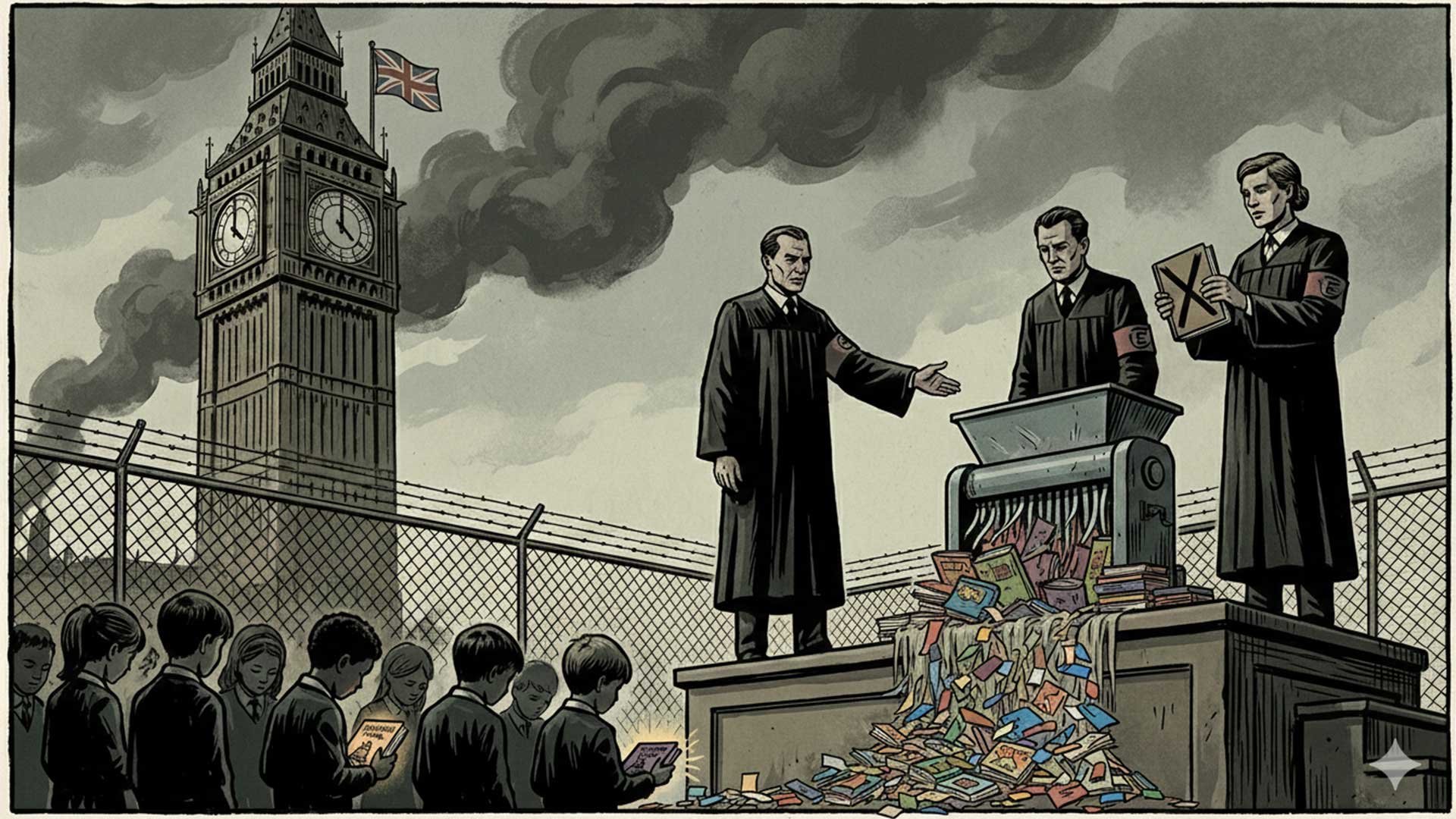
Book banning can sound like an American culture war problem, safely out of mind thousands of miles away across the Atlantic. UK schools do not have state-level “banned book lists” in the same way. Yet pressure to remove books is now a live issue here, and it often arrives dressed as something more reasonable: a “quick safeguarding question”, a “concerned parent query”, or a staffroom discussion about whether a title still feels “appropriate”.
Professional bodies have been warning about this shift for several years. A joint position statement from CILIP and school library groups frames the issue as censorship and intellectual freedom in school libraries. A 2024 Index on Censorship investigation reported that over half of the UK school librarians surveyed had been asked to remove books, with LGBTQ+ titles commonly targeted. In other words, the “ban” is not always a dramatic public battle. It can be a quiet conversation that ends with a book moved off display, boxed away, or simply never ordered again.
What it looks like when a ban is beginning
In UK settings, early-stage censorship tends to be informal and interpersonal. Someone raises a concern and asks for a fast decision: “Should we still stock this?” “Isn’t it safer to remove it?” “Do we want the hassle?” The request might come from a parent, a staff member, a governor, or a senior leader trying to protect the school from complaints.
In social media threads, you can often see typical patterns: arguments about whether children can be trusted to choose; claims that “quality” makes censorship acceptable; comparisons designed to force a yes-or-no purge (“if you remove one author, where do you stop?”); and risk-avoidance reasoning (“take it off now to prevent parent issues later”).
Those moves matter because they change the question. Instead of “Is this book right for these pupils, in this context, with professional support?”, the question becomes “How do we avoid conflict?” That is how libraries shrink without a single formal ban being announced.
What the US teaches us about the playbook
The US has longer experience, and that experience is useful because a lot of the same tactics travel online. PEN America documented thousands of school book bans each year, concentrated in particular states and districts, with repeated patterns in the types of books targeted. The American Library Association has also reported that most censorship attempts now originate from organised movements, not lone complainants.
That “organised” feel is one of the biggest warning signs UK educators should watch for. It often shows up as:
- Scripted language that sounds imported, especially claims about “pornography” or “grooming” applied broadly rather than to specific content.
- Lists of books and authors to remove, sometimes with screenshots of isolated pages, circulated without context.
- A demand for speed, framed as safeguarding urgency, with little appetite for a review process.
- A push for blanket rules, like “no books with X theme”, rather than age-banded guidance.
- A shift from selection to suspicion, where staff stop ordering anything that might trigger complaints.
US educator guidance is clear on what works best in the moment: don’t improvise, don’t debate purely on social media terms, and don’t make a lone librarian or class teacher carry the decision. The National Coalition Against Censorship’s handbook for educators sets out practical steps for handling challenges, including documenting complaints, using established selection criteria, and involving leadership.
The “reasonable” arguments, and how to dismantle them
Most book-ban campaigns are persuasive because they purloin the language of care. Here are common frames, and grounded ways to respond.
- “This is just safeguarding.” Safeguarding is real, but it is not a shortcut for bypassing professional review. Ask for specificity: Which pages, which concerns, which age group, and what harm is being alleged? Then move the discussion into process: a documented complaint, a review panel, and a clear decision record. That keeps safeguarding connected to evidence, not panic.
- “Children are too young to decide.” Children do not choose in a vacuum in schools. They choose inside a curated collection, with staff guidance, reading levels, and pastoral awareness. Removing choice wholesale can backfire, especially when reading engagement is already fragile. Research consistently links reading for pleasure and autonomy with motivation and attainment.
- “We’re not banning, we’re just not promoting it.” Sometimes that is an appropriate compromise, but it can slide into “soft censorship”: the book stays technically available while being hidden, discouraged, or made socially risky to borrow. Index on Censorship reporting described discreet forms of removal and self-censorship pressures on librarians. If you take this route, be honest about what is happening and why, and time-limit it while a proper review takes place.
- “If we remove one, we must remove all the ‘problematic’ authors.” This is a false binary designed to force a purge. Collection management is not moral perfection. A workable approach is to assess the specific text, the specific concern, and the specific cohort, then decide what support is needed: guidance notes, contextual teaching, age-banding, or replacing a title with alternatives.
- “It’s censorship if you remove it, but it’s fine if I personally dislike it.” This is where written criteria help. When decisions are based on documented selection principles, curriculum relevance, age suitability, literary merit, demand, and balanced representation, you are not operating on taste alone. CILIP’s school library guidance is designed for exactly this kind of situation.
Why “mob rule” is a British values problem, not just a culture-war argument
UK schools in England have a duty to promote fundamental British values as part of SMSC, including democracy, the rule of law, individual liberty, and mutual respect and tolerance. Ofsted’s inspection framework also sets expectations around school culture and how leaders create safe, respectful environments for pupils.
That matters because book-ban dynamics often mimic the opposite of those values: decisions made by the loudest voices, rushed judgments without evidence, and pressure on staff to comply without discussion. When an author or book is targeted through gossip, headlines, or “no smoke without fire” reasoning, schools risk modelling the very thing they are meant to counter: punishment without due process.
A practical way to keep this process values-led is to separate two questions:
- What do we know that is evidenced and verifiable?
- What do we feel, fear, or assume based on second-hand claims?
Schools do not need to become courts. They do need fair process.
Cancellation is not just about one author
The UK debate often focuses on a single figure, then treats removal as a simple ethical choice. Publishing does not work like that. A cancelled book involves many workers: editors, copy-editors, proofreaders, designers, illustrators, photographers, publicists, agents, translators, typesetters, printers, and booksellers.
US data makes that labour impact visible. PEN America notes that bans affect not only authors but also illustrators and translators across thousands of titles. The lesson for UK schools is straightforward: when you decide to purge a book as a symbolic act, you are rarely “only” punishing the headline name.
The Kate Clanchy controversy is a UK case study in how quickly reputational storms escalate, how institutions respond under pressure, and how debates about harm and accountability can become entangled with social media dynamics and publishing decisions. Whether someone views that episode primarily as overdue critique or as a cautionary tale about pile-ons, it illustrates why schools need stable procedures rather than reactive swings.
What schools can do now: a simple, workable toolkit
The strongest defence against book bans is boring, written, and repeatable.
- Write a challenge procedure and stick to it. Use clear steps: who receives a complaint, how it is recorded, who reviews it, what criteria are applied, and how the decision is communicated. NCAC’s educator handbook is a practical model, even though it is US-based.
- Build a review panel before you need one. Include the librarian where you have one, a senior leader, a governor, and staff with SEND and safeguarding expertise. The point is not to politicise the issue. It is to stop lone staff members being cornered into rushed decisions.
- Keep the argument anchored in the text. Ask challengers to cite specific passages and specific harms, not general reputational claims. Where appropriate, consider age-banding, contextual teaching, or pairing texts, rather than removal.
- Plan your communications. Parents often want reassurance that schools take concerns seriously. You can give that without conceding to censorship. Explain your process, your criteria, and your commitment to pupils’ wellbeing and reading development.
- Protect staff from online pile-ons. Make it explicit that staff will not be expected to fight these battles in Facebook comments or WhatsApp groups. Decisions should be documented, school-owned, and professionally framed.
- Use a published policy as a starting point. School Reading List has published an “Author and Illustrator Allegations Policy” designed to keep responses evidence-led and consistent, covering roles beyond the author and setting out a process for handling allegations.
One last word on free speech
In practice, the free speech question in schools is rarely “can someone speak?” It is “who gets to decide what everyone else can read?” In a plural society, one family’s objection cannot become another child’s restriction by default. The job of a school library is not to mirror one worldview. It is to offer a safe, age-appropriate, professionally curated range of books that helps pupils learn about themselves and other people.
Before any of us likes, shares, or piles onto a call to remove a book, it is worth pausing on three checks: What is the evidence? What is the process? Who is being silenced?
That is not American politics. That is not a UK culture war. That is basic professional practice, and it fits the values schools are already expected to teach.
Further reading and resources:
- Joint guidance from CILIP, the School Library Association and CILIP’s School Libraries Group on intellectual freedom and handling censorship issues in school libraries.
- CILIP news release responding to censorship pressures in school libraries and reiterating the sector’s position (Sept 2024).
- Index on Censorship investigation reporting a UK survey of school librarians, including removal requests and which topics are commonly targeted (Aug 2024).
- Guardian report summarising the Index on Censorship survey findings on UK school librarians being asked to remove LGBTQ+ books (Aug 2024).
- PEN America’s 2024–2025 Index of School Book Bans, including counts of ban instances and where they occurred.
- PEN America’s 2023–2024 Index of School Book Bans, providing a comparable year’s dataset and totals.
- NCAC handbook for educators on how to manage book challenges using written policy, due process and documented review steps.
- American Library Association page summarising 2024 censorship initiators, showing the share linked to pressure groups and decision-makers (not just parents).
- ALA page on the “Top 10 Most Challenged Books of 2024”, including summary statistics about where challenges originate.
- UK government SMSC guidance document defining fundamental British values and how schools are expected to promote them.
- UK government announcement page that sets out the same British values framing in accessible form (Nov 2014).
- Ofsted Education Inspection Framework (for use from November 2025), outlining how inspection evaluates key areas including culture, behaviour and personal development.
- OECD summary noting that PISA 2018 found reading for enjoyment is positively associated with reading performance across participating countries.
- UK government-archived evidence review on reading for pleasure, summarising research links between enjoyment, frequency and attainment.
- School Reading List’s “Author and Illustrator Allegations Policy”, setting out a structured, evidence-led approach to concerns about book contributors.
- Guardian report on the Kate Clanchy controversy and the reissue of Some Kids I Taught and What They Taught Me after the original publisher parted company (Feb 2022).
- Guardian report on Kate Clanchy’s stated plans to rewrite the memoir following criticism of racial and ableist tropes (Aug 2021).
Episode 38 chapter markers
Part 1
- A rundown of recent book post.
- Top 30 recommended children’s and YA books coming out in February 2026.
Part 2
Part 3
Episode 36 credits
To see full details of licensing information, Creative Commons, GNU license credits and other attributions that apply to every episode of this podcast, see our School Reading List podcast credits information page.
Credits specific to this episode
- Kevin MacLeod – Bummin on Tremelo – (purchased lifetime extended license registered to Tom Tolkien license ID FML-170359-11969).
- Listener submitted monologues from debut and self-published authors. For more details, see the podcast episode’s details page.
Ask us a question | Leave us a voicemail shout-out
Click the button below to leave us a voicemail via SpeakPipe, if you would like to ask a question for one of our listeners’ message slots, leave a shout-out or be featured in a future episode.
Buy me a coffee
If you found this free podcast useful and you would like to help, please consider a donation through the ‘Buy Me a Coffee’ service. Thanks.