They Sent a Cat to Saturn by Valerie Bloom, illustrated by Ken Wilson-Max – at a glance
The School Reading Lists’ five word review: Brilliant poems rekindle classroom wonder.
Children’s book title: They Sent a Cat to Saturn.
Children’s poet: Valerie Bloom.
Children’s illustrator: Ken Wilson-Max.
Genre: Children’s poetry.
Published by: Otter-Barry Books.
ISBN: 9781915659590.
Recommended for children aged: 5+.
First published: Paperback July 2026.
This children’s book is ideal for: children who love hearing poetry read aloud at school.
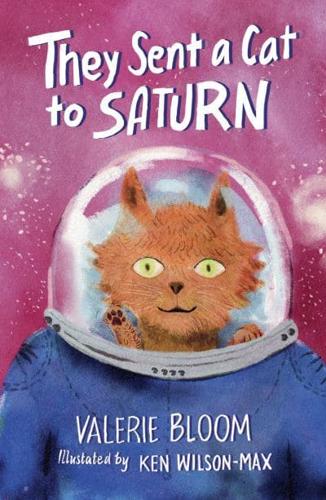
To see the latest price or order, click on the book cover image. As an Amazon Associate, schoolreadinglist.co.uk earns from qualifying purchases.
Our review:
I’m going to be quick because the poems in this brilliant collection speak for themselves.
So that you can fully appreciate how it affected me, I’m going to have to indulge in a little bit of nostalgia (and possibly fantasy).
My primary school was on the most south-westerly tip of Birmingham. We had concrete playgrounds, a lush green field for football, cricket, running and rounders, and a farm just next door with hedgerows and a stream which flowed into the River Rea. The fields baked in summer, the hedges ignited in blossom every spring, autumn filled the nature table, and snow sparkled in winter. Half a mile down Longbridge Lane, Worcestershire began. Another mile and you got to the Worcester Canal. After that, more Worcestershire. In the other direction, by the car factory, there was a railway heading to the West Country, the river, acres of waste ground, woodland and strange copses around which strange tales were woven. Behind my back garden were the ruins of a fortified house encircled by a moat!
Everything we did at school was interesting. Our teachers were all young women who called us by our first names. I remember many trips out of school, and there always seemed to be a project on the go. In darkening December afternoons, the lights came on and we made calendars for the coming year, to be given as Christmas presents.
At the end of every day during the year I was ten, Miss Powell (we all loved her, all forty-four of us) read us something as we waited for the bell: condensed stories from Shakespeare, ancient Greek legends, Dickens and poems by Lewis Carroll, Tennyson and Thomas Hood (you know the ones I mean). That year I came top of the class and sprinted home to tell my Mom. It took only a minute because my front door was less than 100 yards from the school gate. I didn’t dawdle going the other way each morning. And I’m sure that if I had known Miss Powell would be reading some of Valerie Bloom’s poems at the end of the day, I would have got there even quicker.
Teaching points and book club discussion ideas:
- Read the title poem aloud and ask pupils to picture the cat’s journey into space. Which words create the strongest images? Pupils could draw one moment from the journey and label their illustration with phrases taken directly from the poem.
- Explore A Poem Can… as a model for thinking about what poetry can do. Collect pupils’ ideas about how a poem might make someone laugh, remember, imagine, question or feel understood.
- Approach Refuge sensitively by discussing the basic things people need in order to live safely, such as food, water, shelter and freedom from violence. Pupils could identify the contrasts between danger and safety.
- Look at how Valerie Bloom uses humour, exaggeration and surprising situations in poems about pets. Pupils could write a short poem about a badly behaved animal, describing the chaos it causes.
- Discuss how the collection moves between humorous, imaginative and serious subjects.
- Use poems such as Choose and One, Two, Three, Four, Five as starting points for open discussion. What questions did each poem leave pupils thinking about?
- Invite groups to select three poems for a class performance, reading corner or assembly. They should explain why the poems work well together and arrange them in an order that creates an effective change of mood, subject or pace.
Many thanks to Otter-Barry Books for the review copy.
Valerie Bloom and Ken Wilson-Max poetry resources for teachers
- Valerie Bloom’s website features free poetry recordings, poem sheets and classroom activities. Resources based on poems including ‘Autumn Gilt’ and ‘Don’ Go Ova Dere’ explore rhyme, alliteration, descriptive language, performance and Bloom’s use of Jamaican Patois.
- The Children’s Poetry Archive includes recordings of Valerie Bloom performing poems such as ‘Granny Is’, ‘Frost’, ‘The River’, ‘Two Seasons’ and ‘Autumn Gilt’. It also features an interview in which she discusses her inspiration, writing process and approach to performing poetry.
- The Children’s Poetry Archive’s teaching resource for ‘The River’ uses listening, movement, drama and sensory activities to explore rhythm, rhyme, metaphor and personification. Its inclusive, multisensory sequence can be adapted for different ages and learning needs.
- Oak National Academy provides a five-lesson Year 5 English unit using Valerie Bloom’s poetry. Pupils investigate metaphor, symbolism, poetic influences, performance and personal responses while exploring themes including love, anger, belonging and hope.
- The Poetry Society’s free ‘A Journey Through the Senses’ lesson, devised by Valerie Bloom for KS2 and KS3, encourages pupils to build sensory word banks, combine senses in imaginative ways and develop their ideas into original poems.
- Manchester Poetry Library offers an extensive collection of resources based on Stars with Flaming Tails by Valerie Bloom, illustrated by Ken Wilson-Max. Teachers can download a KS2 activity booklet, hear readings and interviews with Bloom and Wilson-Max and watch animations demonstrating Wilson-Max’s illustration process.
- TheOtter-Barry Books page for Stars with Flaming Tails includes a downloadable teaching resource alongside information about the collection’s subjects, characters, poetic forms and illustrations by Ken Wilson-Max.
- The Open University’s Ken Wilson-Max Author Spotlight includes a downloadable classroom version introducing his childhood, reading experiences, books and creative career. It can support an illustrator study or a discussion about how words, pictures and personal experience work together in illustrated poetry.
To order a class set of this book, please click below to order via uk.bookshop.org, an organisation that supports local bookshops, or Amazon.co.uk.
Buy from UK.Bookshop.Org Buy from Amazon.co.uk
Disclosure: If you buy books using the buttons above, we may earn a commission from Bookshop.org, whose fees support independent bookshops; as an Amazon Associate, schoolreadinglist.co.uk earns from qualifying purchases.
Browse our Year 4 reading list.