The Topsy-Turvies – at a glance
The School Reading Lists’ five word review: Joyful chaos flips everyday logic.
Children’s book title: The Topsy-Turvies.
Children’s author: Francesca Simon.
Children’s illustrator: Emily Bolam.
Genre: Children’s fiction – Early Reader, humour.
Published by: Orion Children’s Books.
ISBN: 9781842555293.
Recommended for children aged: 3-8.
First published: Paperback May 2006.
This children’s book is ideal for: children who enjoy silly reversals, visual jokes, and short, confidence-building chapters that reward close looking and make early reading feel like play.
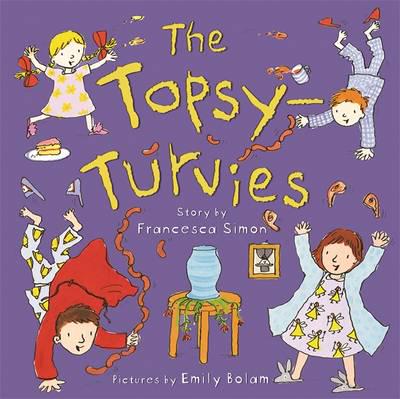
To see the latest price or order, click on the book cover image. As an Amazon Associate, schoolreadinglist.co.uk earns from qualifying purchases.
Our review:
Life at the Topsy-Turvy house runs on its own timetable. Midnight is wake-up time, pyjamas count as day clothes, and breakfast arrives when most families are brushing their teeth. Anything that should be upright is just as likely to be upside down, and everyday objects find new careers. A fork becomes a hairbrush. Sitting on chairs is optional when you can perch under the table. Manners are carefully observed, just not as you might expect.
From the first page the book lets you in on the joke. Portraits hang the wrong way up. The family strolls along on their hands while juggling sausages. The pictures keep nudging you to look again. A TV sits neatly on its stand but the plug trails loose, and the viewers have flipped themselves over to match their worldview. Boots hold kitchen utensils. Flowers sprout from a saucepan. Each spread invites a spot-the-difference game that gets funnier the more you notice.
The Topsy-Turvies are not random. Their rules are consistent and weirdly considerate. When they wake at midnight they dress for day in pyjamas and climb the stairs for dinner, which to them belongs above, not below. Mum’s reminders are gentle. She wants Jinx to show his best table behaviour, which in this house means eating with fingers and toes while using cutlery for grooming. The logic is absurd, yet clear enough that new readers can track the pattern and enjoy how the text and pictures play together.
Trouble arrives from next door when a neighbour asks them to babysit. The family is happy to help. That is when the ordinary becomes baffling. A neat, quiet house with everything the right way round makes no sense to them. Meals happen at set times. The sofa faces forward. Doors open the usual way. Mr Topsy-Turvy can only conclude that the place is very odd indeed. The scene works like a nature documentary in reverse: polite people behaving sensibly within their own culture but completely lost in someone else’s.
The farce peaks when a burglar slips in just as the family is washing their feet before a meal. He finds a home that looks ransacked only because his hosts have made helpful “improvements.” Their calm, contrary routine wrong-foots him at every step until he gives up. The humour never sneers. The intruder is defeated by good manners and cheerful chaos.
The writing delivers quick, clean beats and lets the art do plenty of the work. Repetition sets up the rhythm, then a small twist lands the laugh. Each page offers tiny gags that reward pointing, predicting, and rereading. Children learn to scan and infer without feeling like they are being tested. Adults get easy prompts to keep the chat going: What else is the wrong way round? Why might they do it that way?
A quiet closing line brings the noise down to a gentle truth. Mum Topsy-Turvy says it takes all sorts to make a world. After the juggling and the silliness, that lands softly. Difference is not just tolerated. It is welcomed, and it is useful. For children taking their first steps into longer texts, the short chapters, brisk scene changes, and bold artwork make a friendly bridge between picture books and early readers.
Our verdict:
The Topsy-Turvies is a warm, clever comedy of reversals with its heart exactly where it should be. The jokes come from behaviour rather than mockery, and the family is never the punchline. That keeps the tone kind and the laughter inclusive.
The pictures carry real classroom value. Confident spotters will hoover up the background jokes, while newer readers can enjoy the main gag and feel proud when they notice an extra detail on a second pass. The babysitting chapter is a standout because it flips the perspective. In the neighbour’s tidy home, the Topsy-Turvies are the ones who feel lost, yet they try to help. That generous impulse powers the final set piece when a burglar meets a house arranged by people who see the world from another angle.
As an Early Reader, it works beautifully. Short lines, well-timed page turns, and bright scenes keep children moving through the chapters. The running jokes about etiquette, like forks for hair and fingers for food, give an easy refrain for shared reading. The final message is simple enough to travel into the playground and the classroom: other people’s normal can look very strange, and that is fine.
It is easy to see this becoming a reliable pick for bedtime, guided reading, or a quick whole-class laugh after lunch. The humour is clean, the art is lively, and the message is calm and clear.
Teaching points and book club discussion ideas:
- Make a “topsy-turvy spotter’s list”: reread a spread and list all the things that are wrong-way-round; compare lists to see what new details others found.
- Talk about routines: map the family’s day and your day side by side; what changes if you swap night and day?
- Manners in context: collect examples of good manners in the book and in your home; discuss how rules can change between families or cultures.
- Safety and sense: the burglar scene – what clues show something is not right, and how do the characters respond sensibly in their own way?
- Creative writing: write three “family rules” for a different upside-down household (e.g., pets give baths to people); illustrate one rule.
- Sequencing: cut up a few lines from the story’s events and ask pupils to put them in order; explain the choices.
- Vocabulary play: find everyday objects in the pictures used in odd ways; label them and invent alternative uses.
- Empathy lens: “What an odd house,” says Mr Topsy-Turvy – discuss how our homes might look odd to someone new; share one thing visitors might find surprising.
- Art: draw a normal room and then redraw it the Topsy-Turvy way; present to the class and explain two changes.
Many thanks to Orion Children’s Books for the review copy.
To order a class set of this book, please click below to order via Amazon.co.uk.
Buy from Amazon.co.ukDisclosure: As an Amazon Associate, schoolreadinglist.co.uk earns from qualifying purchases.
Browse our Year 1 reading list.

